
GA Aircraft
Viator V4T - Overview
Transportation and landing of cargo within the loading range of 900 kg (1984 lb) including in high latitude and upland area environment. It can be operated from unpaved flight strips and unprepared sites. It is possible to install wheel-ski, float-type landing gear and wheels with low-pressure tires.
The machine is equally good for private farming, cargo transporting, small business and extreme tourism, family travel, as a regional ambulance and for special applications Compared to the competitors, this aircraft is more efficient due to for its lifting hood of the loading opening in aft airframe and folding under-tail ramp.
Viator V4T - Turboprop Engine Aircraft
Specification V4T
Weight
1800 kg - MTOM
850 kg - Empty
780 kg - Max Payload
900 kg - Breakpoint Weight
Cargo Dimensions
Size Cargo Salon
3,0х1,4х1,4 (m) - L, W, H
Size Cargo Door
1.4 х 3.5 (m) - W, H
Loading opening gabarit
1.4 x 1.4 (m) - W, H
Volume
8.8 m^3 - All Cab Volume
7 m^3 - Cargo Volume
Other
6200 m - Altitude Ceiling
at least 6 kg/cm2 - Runway Ground Strength
External Dimensions
9 m - Length
3.4 m - Height
11.4 m - Wing Span
Seating Capacity
1 pax - Crew
5 pax - Passengers
Turboprop Engine
Allison 250-B17F
450 hp - Power
Takeoff & Landing
115 m - Take off Runway
110 m - Landing Runway
Speed
340 km/h - Never-Exceed Speed
220 - 290 km/h Cruising Speed
88 km/h - Takeoff Speed
76 km/h - Stall Speed
7.6 m/s - Ascensional Rate
Fuel
JP-4 Aviation Kerosene
300 L - Fuel Capacity
Range
900 km - Max Fuel Range
600 km - Max Payload Range
Engine power - 450hp
The basic configuration is equipped with Allison 250-B17F turboprop engine, which allows to V4T develop speeds of up to 340km/h with payload 780kg.
Allison 250-B17F turboprop approved by FAA. Additional configuration with navigation and communication equipment is provided upon request.
V4T aircraft with the take-off weight 1800kg and a powerful turboprop aero-engine in the basic configuration lifts cargo weighing up to 780kg and has delivery range of up to 600km. The fuselage is equipped with a cargo hatch with a ramp. In the passenger version the aircraft capacity is 5 people plus a pilot.
Possible Applications
Transformability and modularity of cargo-passenger cabin is provided structurally, including to replace passenger seats or a set of rigging equipment. Worked out options for the replacement of conventional wheeled chassis on wheels super low pressure for loose and water logged unpaved runways, as well as options with the chassis of the float, ski, float-wheel and ski-wheel types. Airplane equipped with a ramp to facilitate loading and unloading.
Thanks to the developed mechanization of the wing, the aircraft can take off and land on a relatively small of size landing grounds.
Passenger and cargo-passenger carrying operations at a short-haul and mid-range distance
Transportation of full-size cargo, baggage, mail, sports equipment
Aircraft special purpose when performing patrol and search and rescue flights
Agriculture air support
Air transport of wrecking-medical units and emergency services
Private aircraft and pilot training
Airdrop vehicle in extreme sports and tourism
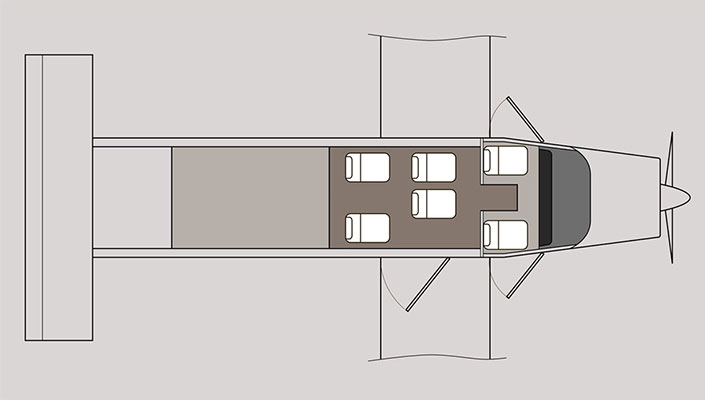
Basic Passenger Version
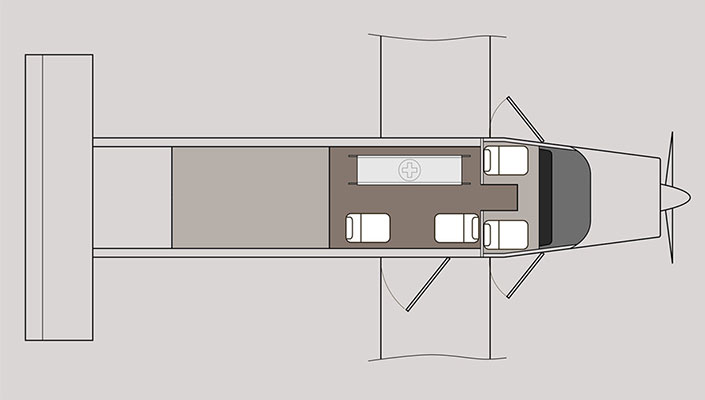
Medical Version
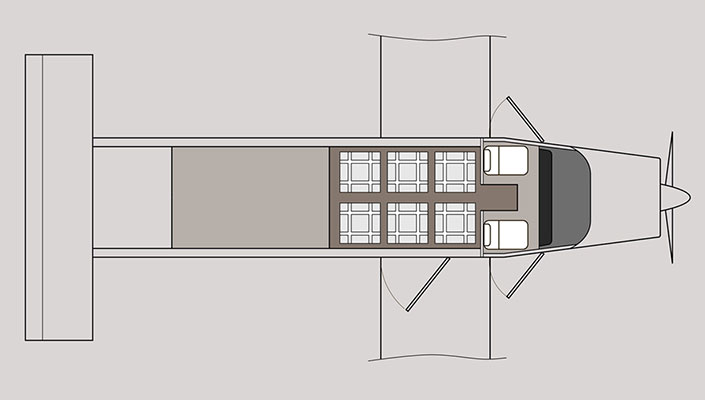
Cargo Version
Further modification of the aircraft can be
Setting the floats (seaplane or amphibious modification)
Installing the «ski+wheel» langing gear
Installation of a set of on-board equipment according to the customer's specification
Modification with increased fuel capacity
Adaptation with the more powerful or the client's specified engine
Market assessment
Demand in the world, according to the analysis of the State Research Institute of Civil Aviation, estimated at 1,500 aircrafts of this class by 2030.
CIS market capacity is estimated at 300-500 aircraft.
The competitive effect of self-cost reduction will be noticeable with an annual production program of at
least 18-20 machines.
Certification of the type air vehicle is an independent investment issue.
We are ready to export manufactured aircraft designs and sell the license for their production.
Aircraft description
Fuselage
The fuselage structure provides approaches to aircraft systems and units, ease of boarding and exit of
pilot and passengers through the side doors, high-visibility cockpit, ease loading and unloading of full-sized
cargo.
Riveted all-metal fuselage (aluminum alloy) consists of a frame structure and a skinning. The cargo-
passenger salon is located in the middle part of the fuselage. Loading opening is located in the aft of cargo-passenger salon and equipped with folding load under-tail ramp as well as opening up tail cowl. The booms are an extension of the fuselage sidewalls.
Wing
The aircraft has a high wing, rectangular in plan, single-spar, with retractable slotted flaps. The wing butting to the fuselage at the nodes of spar and the rear wall. The wing equipped a maintenance hatches for maintenance located in it of units and systems.
Tail
The airplane tail unit has a gantry form and consists of the HTP and VTP. HTP has a rectangular shape in plan and consists of the stabilizer and elevators with a trim tab. The twin-tailed VTP has a oblique leading edge, trapezoidal at a lateral view and consists of two keels and rudders with trimmer.
Equipment
Navigation and communication equipment, flight mode control equipment, on-board equipment, appliances, avionics: basic configuration is provided, additional (expanding) and custom-made equipment upon request. Additional configuration with navigation and communication equipment is provided upon request.